

We could see smoke in the air — fire, somewhere in the building on the COP30 premises in Belém, Brazil. The rooms emptied, we interrupted our five-minute pause for lunch, the Signal chat started popping up with check-ins from colleagues.
In my mind, before it went anywhere practical, i looked around: the stairs, the narrow corridors, the pile of cables on the floor, the absence of ramps. In that moment, the everyday infrastructure of a United Nations climate conference revealed itself for what it is: a set of choices. Choices about who is expected to be there, whose presence is assumed, and therefore, whose voice has been built into the room from the start.
That small moment of alarm spoke louder than its sound. Emergency infrastructure is a mirror. It reflects whose safety is considered by default. And if persons with disabilities are not built into the evacuation plan, they are not fully built into the political project either. If the room cannot be safely exited by everyone, we should ask ourselves: who is it truly designed for?
A year of challenging my own perceptions
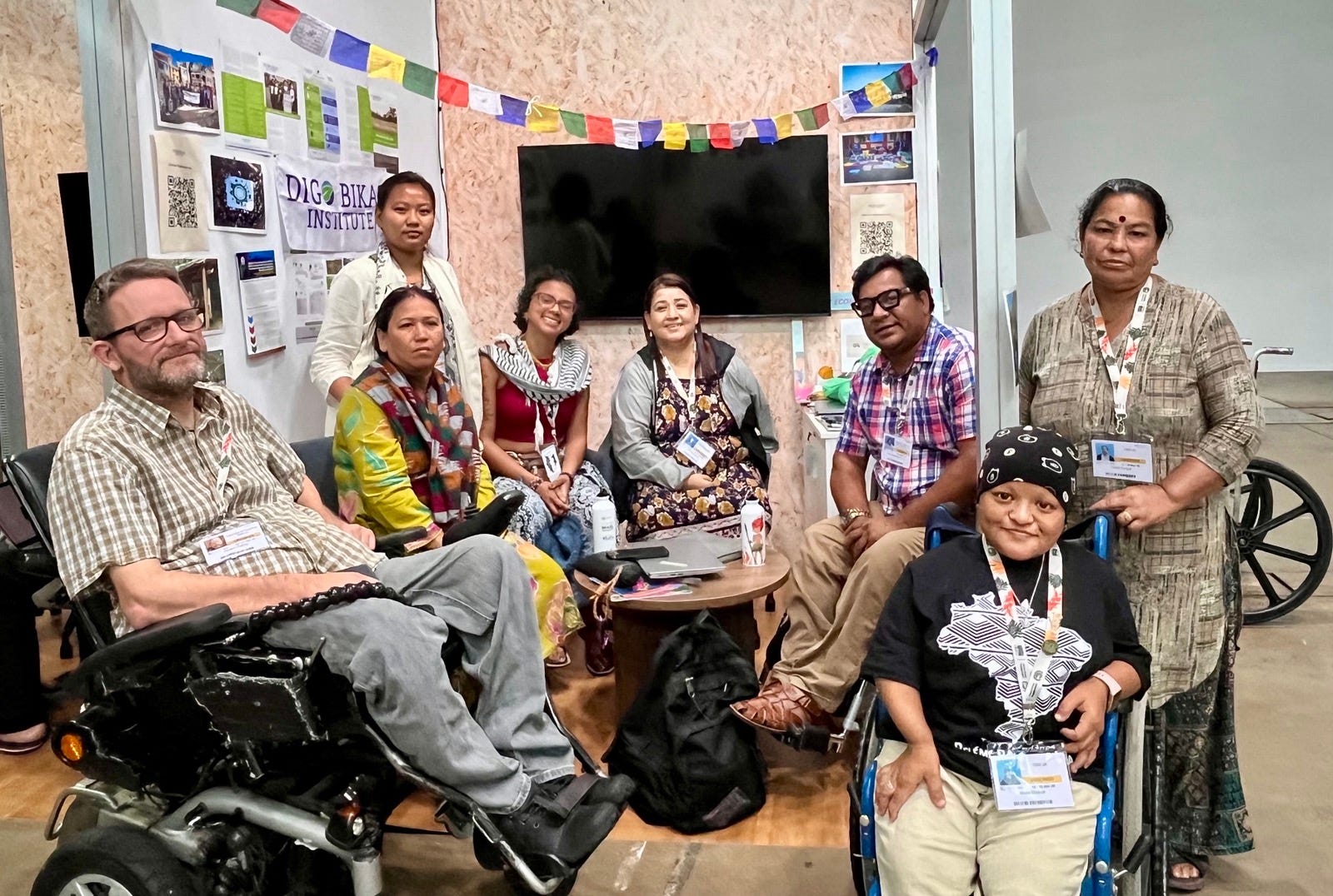
Photo: Meeting with disability rights advocates and Indigenous People’s Constituency leadership, 2025, Belém
Over the past year, i had the honour of facilitating the formal recognition of the Disability Caucus within the UNFCCC, a process that brought together Organizations of Persons with Disabilities (OPDs), climate advocates, Indigenous leadership, and the UNFCCC Secretariat - a slow, sometimes maddening, ultimately historic process. Today, more than 100 organisations have endorsed this milestone and are part of it.
This process did not begin with my intervention. It was the continuation of a trajectory forged by disability rights advocates who were determined to shift the normalisation of being an afterthought in the climate agenda. It counted on the generous exchange and sharing of the learnings and challenges from the Women and Gender Constituency, Climate Action Network, Demand Climate Justice, and YOUNGO, those right-holder constituencies who have walked a long journey towards justice.
I did not arrive at this work as a disability rights expert. I arrived as a climate justice and feminist advocate who found herself in the right place to share deep enough understanding of how multilateral processes work, leveraging her experience facilitating challenging conversations about governance structures.
And it challenged and renewed my experience organizing. Not in the performative way that ‘allyship journeys’ are often narrated as a story of personal enlightenment. But in the quieter, more material way that comes from sitting in workshops and realizing you have been imagining your audience as a default body. I learned to think about who is speaking when i describe a panelist verbally. For someone who cannot see them, the image of who is at the microphone was constructed entirely through my words; through the images of light and identity that i was choosing to translate into spoken sentences: red glasses, curly hair, coffee bean earrings, orchid tattoos in her arms, wearing a black and white keffiyeh.
I learned that breaking out into small groups in a Zoom call is not a neutral facilitation technique; it requires technical infrastructure and a knowledgeable support person to facilitate smooth conversations among English, Spanish, Portuguese, Azerbaijani, captions, and sign languages. For this, i am deeply grateful to Debbie and all the interpreters, who supported throughout this process with such calmness and professionalism that they gave me the confidence to dive into each session. These are not just add-ons. They are part of the substance of inclusion.
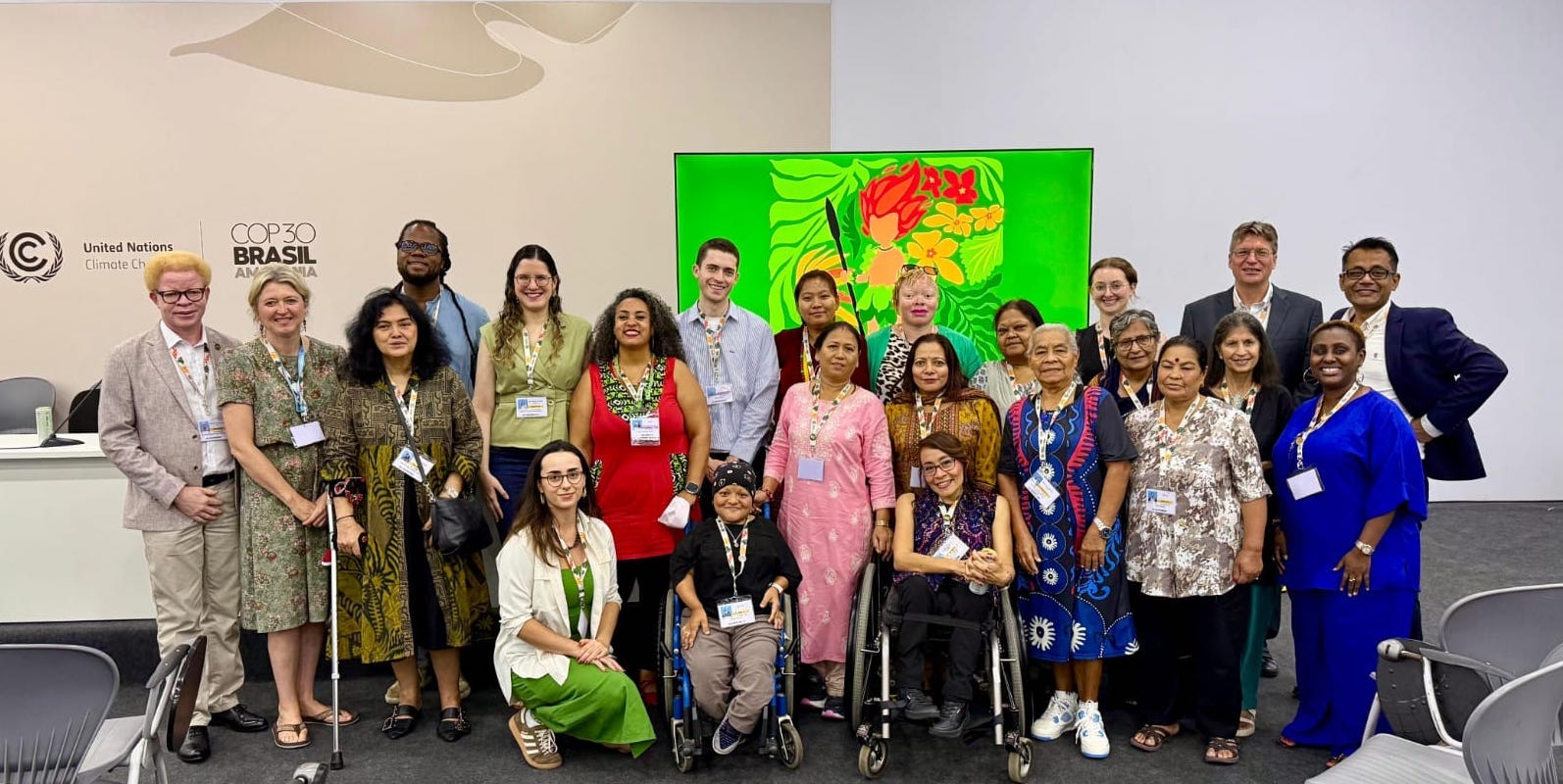
Photo: UNFCCC Disability Caucus meeting, 2025, Belém
Under the bureaucracy of recognition
Facilitating the official recognition of the Disability Caucus was, in equal parts, a political process and a bureaucratic endurance sport. The UNFCCC Secretariat operates on its own timeline, with its own internal logic, and navigating it requires a particular kind of patience –to put it one way- the kind that does not confuse moving slowly with moving backwards. There were moments of stagnation that felt like defeat, and moments of unexpected progress that felt like grace.
The process also required stops along the way to reconsider the approach, adapt to the pace and needs of discussions and agreements, walk through divergent views and deep emotions, and, above all, to intentionally reflect on each methodology, communication, and step forward. My role was to facilitate, to connect, to push when needed, and step back when required.
Questions of governance - who leads, how decisions are made, what principles anchor common advocacy - cannot be assumed or shortcut. Thoughtful exchanges with the Indigenous Peoples group sealed this process, addressing the gaps between interconnected realities. I learned again, as i have done it throughout the years engaging with diverse movements and government representatives, that the most important political work often happens in the conversations that do not appear on any official agenda. The workshops designed and facilitated to build shared terms of reference were not just a procedural step; they were where the actual politics lived.
Central to this work was something i hold as a non-negotiable: OPDs must lead. Not just be consulted. Not just be invited as guests into a process shaped by others. This is part of the language of justice applied to governance, recognizing that the authority to define the terms of one’s own struggle belongs to those who live that struggle.
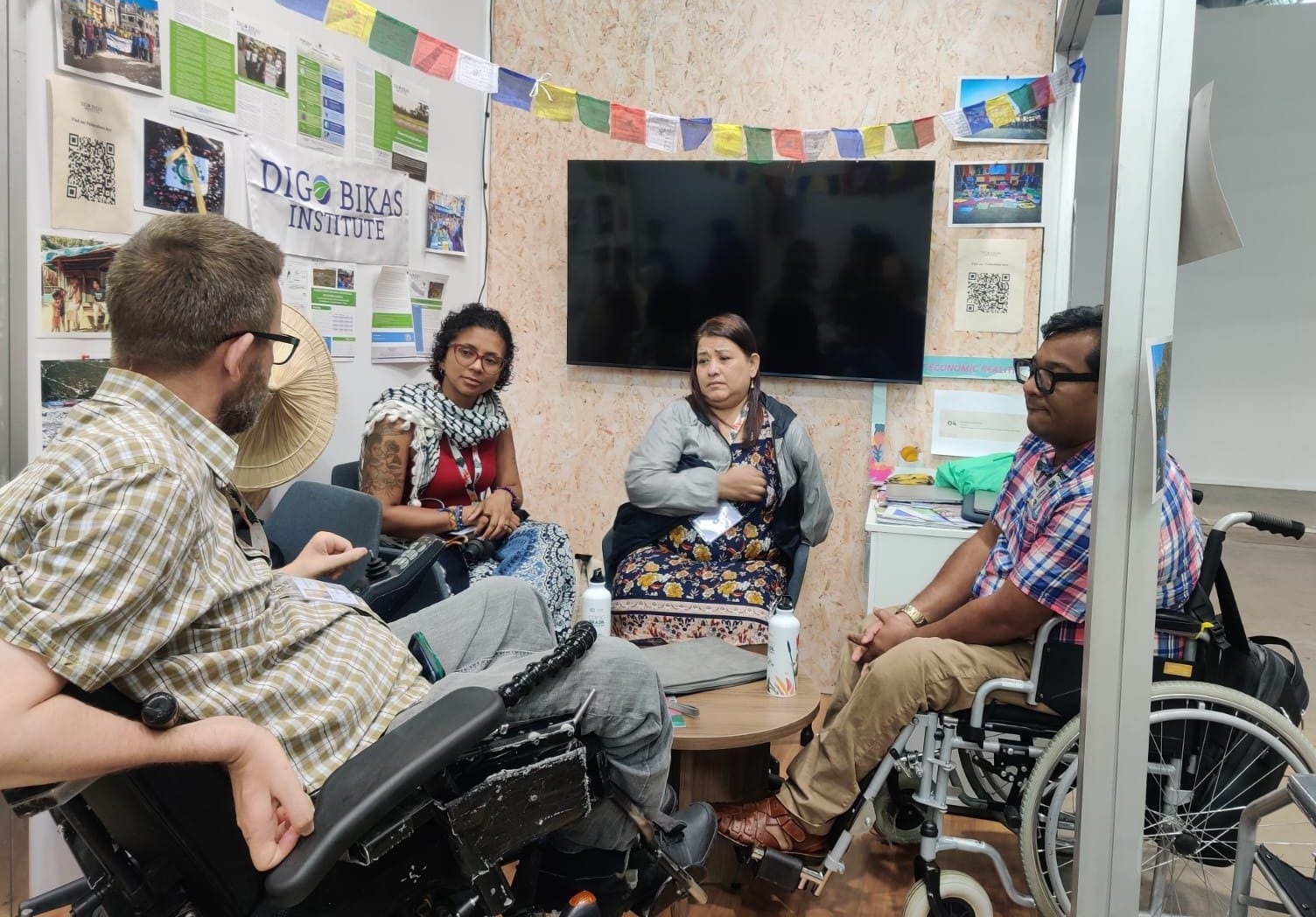
Photo: Meeting with disability rights advocates and Indigenous People’s Constituency leadership, 2025, Belém
Inclusion is not a checkbox
I want to be careful here when i say ‘inclusion,’ because the word has been so thoroughly absorbed into institutional language that it risks meaning nothing at all. In the climate policy world - and especially in just transition discourse - inclusion has too often become a list. Indigenous peoples: check. Women and girls: check. Youth: check. Persons with disabilities: not yet on the list, but working on it. The mantra of “leaving no one behind” turned into an empty shopping list.
This framing is not only inadequate but also actively misleading. It suggests that justice is achieved by adding more categories of people to a process that remains structurally unchanged. It treats representation as an end in itself, rather than diving into harder questions: representation in service of what? Whose knowledge counts as expertise? Who has the power and accessibility to the spaces that define what a ‘just transition’ actually requires?
Persons with disabilities are among those most acutely exposed to the impacts of climate change: through disrupted healthcare systems, inaccessible evacuation routes, destroyed assistive technologies, and heightened vulnerability in extreme heat, flooding, and displacement. And yet the systems being built in the name of just transition - renewable energy infrastructure, green urban mobility, climate finance mechanisms - are routinely designed without disability in mind. This is not an oversight. It is, again, a political choice, reflecting whose needs are imagined as normal and therefore universal. Universal. Cis. Human. White – but let me park that for another piece.
A transformative approach to just transition must start from a different premise: that disability is not an edge case or an additional consideration, but a constitutive lens. When you design for all bodies and ask what a genuinely accessible, dignified, and safe world looks like for someone with complex mobility needs, or chronic illness, or sensory difference - you end up designing better for everyone. And more importantly, you end up building political processes that are accountable to the full range of body experiences.
Still with the sound of the fire alarm in the room
I often think about that fire alarm in Belém. I think about who was in that room, who could leave it safely, and who was designing the next round of climate finance mechanisms the following morning. These are not separate questions. The architecture of a building and the architecture of a policy are made of the same material: assumptions about who matters, whose needs are default, and whose are supplementary.
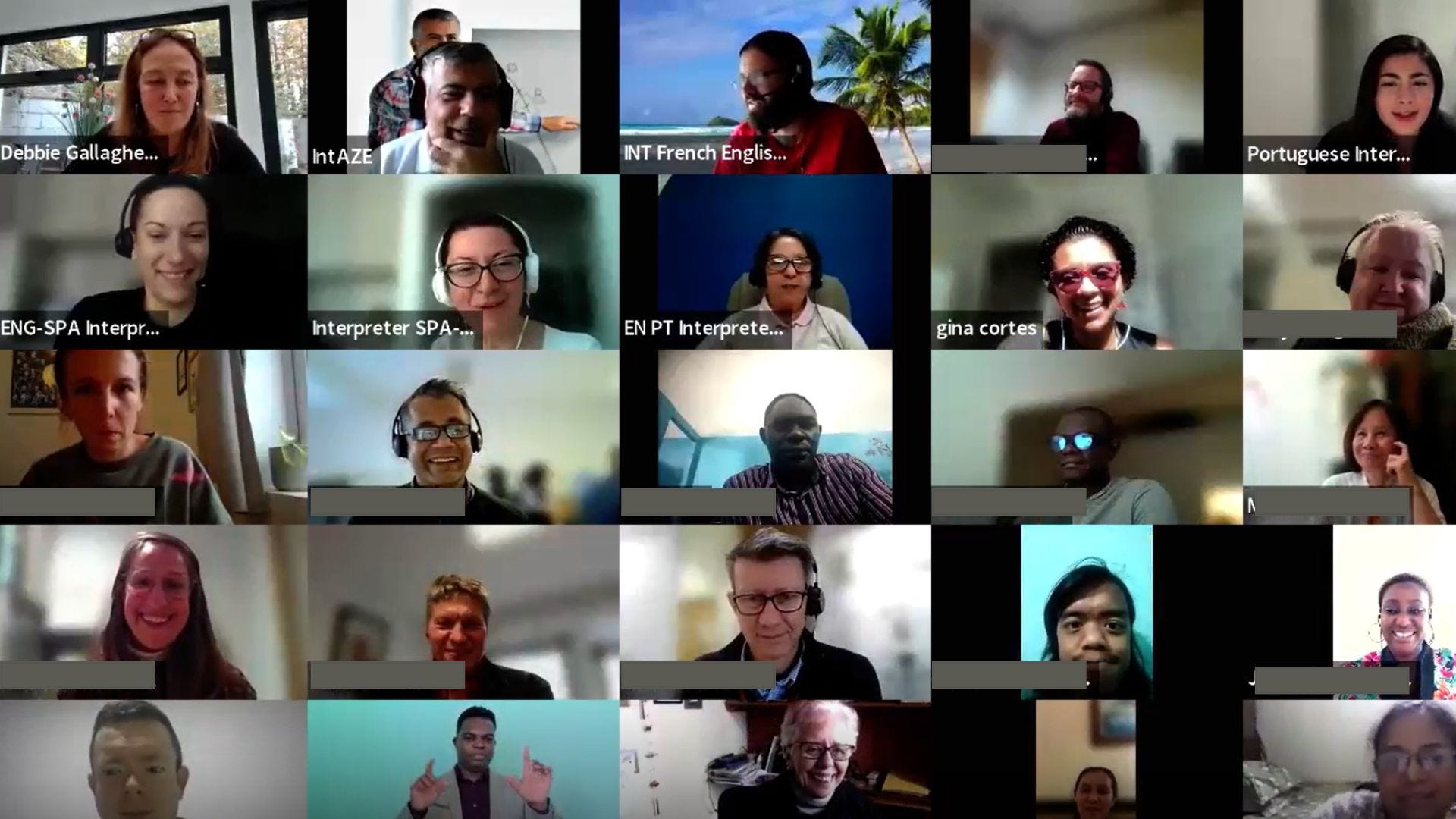
Photo: Online workshops held towards UNFCCC recognition, 2025
The formal recognition of the Disability Caucus at the UNFCCC is a genuine win, one fought for with extraordinary dedication by disability rights advocates and OPD leaders whose persistence made it possible long before i arrived to the process. What it opens is a seat at the table. What happens with that seat depends on whether the rest of the climate movement takes disability justice seriously as a structural demand -not an add-on, not a checkbox, not a sensitivity training- but a fundamental rethinking of who the future is being built for.
I believe it can be. I have seen what becomes possible when movements genuinely learn from each other, when facilitation creates real space for disagreement and convergence, and when the bureaucratic slowness of multilateral processes is met with political clarity to come out the other side with something real. That belief is not naive. It is made of the hours spent in those workshops, in those conversations, and in the room, which, for all of us, must be one we can actually leave.
Me encanta leerte por acá, que valiosas miradas me enriquecen montones!
A very good reflections and capturing @gina (she/ella)